
Dermatology: Pruritic Skin Disease Distance Education

Dermatology: Pruritic Skin Disease Distance Education

Skin problems are among the most common reason for presentation in everyday practice. 

The CVE’s Dermatology Distance Education Program consists of three courses, Pruritic Disease, Infectious Disease and Advanced Dermatology. The emphasis of the program is on deepening your personal logical approach to case management. The courses review the latest information available on a wide range of conditions and presents the latest evidence-based treatment options available. Ultimately, having more confidence in your abilities to manage skin patients will lead to better outcomes and higher personal satisfaction.


The Pruritic Skin Disease DE course will cover the various common causes of pruritus: including insect hypersensitivities, atopic and contact dermatitis as well as food allergies, Malassezia dermatitis and pruritic parasitic skin diseases. The pathophysiology of pruritus, including neurogenic and psychogenic pruritus will be reviewed with an emphasis on current and upcoming treatment modalities. 

If you are only interested in completing part of the program, both the Pruritic and Infectious Disease courses start with the introductory module that covers the general approach to a dermatology patient. It also features practical work with microscopy and skin biopsy sampling conducted on-line and the key steps in the approach to nodules. If you are interested in the Advanced course please note that the infectious and pruritic courses are pre-requisites for enrollment. 

Note: If you have previously completed the introductory module, you do not need to complete it again and your start day is 1st of March 2026.

Past Participant:

Very friendly and supporting tutors- I feel I made a big step in the right direction! Thanks!
Andrea

I very much appreciated the visual examples of the different cases, both as presenting complaints as well as cytology etc.  I found these extremely beneficial and could have used even more of them. Also, the links to the dermatology webinars/conference presentations was an excellent resource to have.
Julie Morrow

Learning Outcomes

After successful completion of this course, you will be able to:

  • Develop a logical, problem-based approach to the investigation of pruritic skin cases.
  • Choose relevant tests based on clinical signs and history and feel confident regarding the minimum database required to reach a definitive diagnosis for each pruritic patient.
  • Provide your clients and patients with the latest evidence-based treatments for a range of pruritic diseases.
  • Consider the cost-benefit analysis of each treatment.

Modules

  • Introductory Module
  • Pruritus - understanding pathophysiology will affect your approach and treatments.
  • Insect bite hypersensitivities in the dog and cat - when to use what.
  • Atopic Dermatitis - recognize the many flare factors and optimize management.
  • Contact Dermatitis - although the least common allergy, this can be tricky.
  • Food Allergy - diets, alternative tests and long-term options.
  • Malassezia Dermatitis - as it relates to the management of pruritus.
  • Pruritic Parasitic Skin Diseases 

* The introductory module only needs to be completed once so if you have already completed this module, as part of another CVE Dermatology course, you do not need to enroll in it again. In this case, please select the course registration option that excludes the introductory module.

Workshop/s

 
  • 1-day workshop as part of the introductory module (if not completed previously)
  • 1-day workshop as part of the Pruritic Skin Disease Distance Education course.

Dermatology Program

Our year-long Dermatology Distance Education program has been broken down into 3 manageable and independent parts: Pruritic Skin Disease, Infectious Skin Disease and Advanced Dermatology.
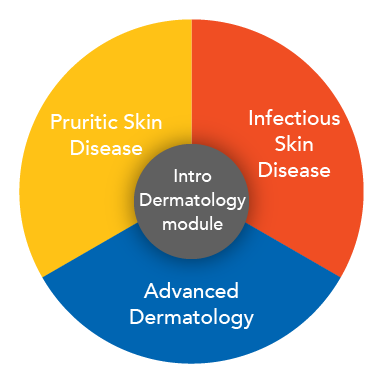
Each is a discrete course on its own but together they form a formidable dermatology educational program. Each course has an interactive workshop – a major drawcard – where you have the opportunity to apply the theory you have learnt under the watchful eye of your tutor. You also benefit from the group experience of learning with, and from, your peers.

The introductory dermatology module is a prerequisite for Pruritic Skin Disease and Infectious Skin Disease courses while you must complete either Pruritic or Infectious Skin Disease course to enrol in the Advanced Dermatology Distance Education course.

Related courses

  • Infectious Skin Disease Distance Education Starts May 2026
  • Advanced Dermatology Distance Education Starts September 2026

What is Distance Education?

Premium, intensive online veterinary CE

All CVE Distance Education (DE) programs are mentored by leading veterinary experts who will provide individual feedback and advice on completion of each monthly module. Each module may include written content, technique videos, self-reflections, quizzes and online submission of monthly assignments.

Maximise the opportunity to expand and consolidate your learning by participating in the tutor moderated group discussion forum and attending the two optional 1-day interactive workshops, with an emphasis on working through case studies and group discussion.

Who should enrol?

This course is ideal for qualified veterinarians looking to expand their expertise in dermatology. 

Registrant Type Non-Member Price  Member Discount  Super Early Bird Price Early Bird Price Full Rate Price
Non-Member / eMember (registration excluding Introduction module) $2,590  -  -  -
$2,590
Non-Member / eMember (registration including Introduction module) $3,407  -  -   - $3,407
CVE Members* (registration excluding Introduction module)  -  15%  $2,202 $2,396
$2,461
CVE Members* (registration including Introduction module)  -  15%  $2,896 $3,151
$3,236

*Members include: Practice Member Staff, Professional, Part-time Professional and Recent Graduate.

Distance Education
Monday, 01 February 2027 to
Monday, 31 May 2027
140 CPD Point/s

Super Early Bird
30 Jun 2026
Early Bird
31 Oct 2026

Delivered Online
Distance Education
Monday, 01 February 2027 to
Monday, 31 May 2027
140 CPD Point/s

Super Early Bird
30 Jun 2026
Early Bird
31 Oct 2026

Delivered Online

Join the CVE

Become a member today to receive member pricing

Join Now

Sponsor/s

There are no records.

Tutor/s

Callum Bennie
BSc(Vet), BVSc, MS, DACVD, MANZCVS Board Certified Veterinary Dermatologist
Dr Callum hails from Sydney’s (now) trendy Inner West and has wanted to be a veterinarian for as long as he can remember. While studying veterinary medicine at the University of Sy...
Sonya Bettenay
BVSc (Hons) FANZCVS (Derm.) DipEd Dipl. ECVD MANZCVS
Sonya Bettenay graduated from The University of Melbourne in 1980. She completed her dermatology residency and achieved board certification in veterinary dermatology with the Austr...
Stefan Hobi
Assoc. Prof. Dr. Med. Vet. Dipl. ECVD and AiCVD
HK registered and European recognized Specialist in Dermatology Head and Clinical Associate Professor in the Department of Veterinary Clinical Sciences Jockey Club College of Vete...
Ralf Mueller
Dr MedVet MANZCVS Dipl. ACVD FANZCVS (Derm.) Dipl. ECVD
Prof. Ralf S. Mueller graduated in Munich/Germany, completed his doctoral thesis in 1987, and worked in several large and small animal practices before completing a residency in ve...
Callum Bennie
BSc(Vet), BVSc, MS, DACVD, MANZCVS Board Certified Veterinary Dermatologist
Dr Callum hails from Sydney’s (now) trendy Inner West and has wanted to be a veterinarian for as long as he can remember. While studying veterinary medicine at the University of Sy...
Sonya Bettenay
BVSc (Hons) FANZCVS (Derm.) DipEd Dipl. ECVD MANZCVS
Sonya Bettenay graduated from The University of Melbourne in 1980. She completed her dermatology residency and achieved board certification in veterinary dermatology with the Austr...
Stefan Hobi
Assoc. Prof. Dr. Med. Vet. Dipl. ECVD and AiCVD
HK registered and European recognized Specialist in Dermatology Head and Clinical Associate Professor in the Department of Veterinary Clinical Sciences Jockey Club College of Vete...
Ralf Mueller
Dr MedVet MANZCVS Dipl. ACVD FANZCVS (Derm.) Dipl. ECVD
Prof. Ralf S. Mueller graduated in Munich/Germany, completed his doctoral thesis in 1987, and worked in several large and small animal practices before completing a residency in ve...

Invalid Event Selection

This event either doesn't exist or is no longer available.

Return to Continuing Education

Dermatology: Pruritic Skin Disease Distance Education

veterinary dermatology
Develop a logical, problem-based approach to the investigation of pruritic skin cases. The Pruritic Skin Disease DE course will cover the various common causes of pruritus: including insect hypersensitivities, atopic and contact dermatitis as well as food allergies, Malassezia dermatitis and pruritic parasitic skin diseases.  The pathophysiology of pruritus, including neurogenic and psychogenic pruritus will be reviewed with an emphasis on current and upcoming treatment modalities.

Skin problems are among the most common reason for presentation in everyday practice. 

The CVE’s Dermatology Distance Education Program consists of three courses, Pruritic Disease, Infectious Disease and Advanced Dermatology. The emphasis of the program is on deepening your personal logical approach to case management. The courses review the latest information available on a wide range of conditions and presents the latest evidence-based treatment options available. Ultimately, having more confidence in your abilities to manage skin patients will lead to better outcomes and higher personal satisfaction.


The Pruritic Skin Disease DE course will cover the various common causes of pruritus: including insect hypersensitivities, atopic and contact dermatitis as well as food allergies, Malassezia dermatitis and pruritic parasitic skin diseases. The pathophysiology of pruritus, including neurogenic and psychogenic pruritus will be reviewed with an emphasis on current and upcoming treatment modalities. 

If you are only interested in completing part of the program, both the Pruritic and Infectious Disease courses start with the introductory module that covers the general approach to a dermatology patient. It also features practical work with microscopy and skin biopsy sampling conducted on-line and the key steps in the approach to nodules. If you are interested in the Advanced course please note that the infectious and pruritic courses are pre-requisites for enrollment. 

Note: If you have previously completed the introductory module, you do not need to complete it again and your start day is 1st of March 2026.

Past Participant:

Very friendly and supporting tutors- I feel I made a big step in the right direction! Thanks!
Andrea

I very much appreciated the visual examples of the different cases, both as presenting complaints as well as cytology etc.  I found these extremely beneficial and could have used even more of them. Also, the links to the dermatology webinars/conference presentations was an excellent resource to have.
Julie Morrow

Learning Outcomes

After successful completion of this course, you will be able to:

  • Develop a logical, problem-based approach to the investigation of pruritic skin cases.
  • Choose relevant tests based on clinical signs and history and feel confident regarding the minimum database required to reach a definitive diagnosis for each pruritic patient.
  • Provide your clients and patients with the latest evidence-based treatments for a range of pruritic diseases.
  • Consider the cost-benefit analysis of each treatment.

Modules

  • Introductory Module
  • Pruritus - understanding pathophysiology will affect your approach and treatments.
  • Insect bite hypersensitivities in the dog and cat - when to use what.
  • Atopic Dermatitis - recognize the many flare factors and optimize management.
  • Contact Dermatitis - although the least common allergy, this can be tricky.
  • Food Allergy - diets, alternative tests and long-term options.
  • Malassezia Dermatitis - as it relates to the management of pruritus.
  • Pruritic Parasitic Skin Diseases 

* The introductory module only needs to be completed once so if you have already completed this module, as part of another CVE Dermatology course, you do not need to enroll in it again. In this case, please select the course registration option that excludes the introductory module.

Workshop/s

 
  • 1-day workshop as part of the introductory module (if not completed previously)
  • 1-day workshop as part of the Pruritic Skin Disease Distance Education course.

Dermatology Program

Our year-long Dermatology Distance Education program has been broken down into 3 manageable and independent parts: Pruritic Skin Disease, Infectious Skin Disease and Advanced Dermatology.

Each is a discrete course on its own but together they form a formidable dermatology educational program. Each course has an interactive workshop – a major drawcard – where you have the opportunity to apply the theory you have learnt under the watchful eye of your tutor. You also benefit from the group experience of learning with, and from, your peers.

The introductory dermatology module is a prerequisite for Pruritic Skin Disease and Infectious Skin Disease courses while you must complete either Pruritic or Infectious Skin Disease course to enrol in the Advanced Dermatology Distance Education course.

Related courses

  • Infectious Skin Disease Distance Education Starts May 2026
  • Advanced Dermatology Distance Education Starts September 2026

What is Distance Education?

Premium, intensive online veterinary CE

All CVE Distance Education (DE) programs are mentored by leading veterinary experts who will provide individual feedback and advice on completion of each monthly module. Each module may include written content, technique videos, self-reflections, quizzes and online submission of monthly assignments.

Maximise the opportunity to expand and consolidate your learning by participating in the tutor moderated group discussion forum and attending the two optional 1-day interactive workshops, with an emphasis on working through case studies and group discussion.

Who should enrol?

This course is ideal for qualified veterinarians looking to expand their expertise in dermatology. 

Registrant Type Non-Member Price  Member Discount  Super Early Bird Price Early Bird Price Full Rate Price
Non-Member / eMember (registration excluding Introduction module) $2,590  -  -  -
$2,590
Non-Member / eMember (registration including Introduction module) $3,407  -  -   - $3,407
CVE Members* (registration excluding Introduction module)  -  15%  $2,202 $2,396
$2,461
CVE Members* (registration including Introduction module)  -  15%  $2,896 $3,151
$3,236

*Members include: Practice Member Staff, Professional, Part-time Professional and Recent Graduate.

When
1/02/2027 9:00 AM - 31/05/2027 11:59 PM
AUS Eastern Summer Time
Where
Online, NSW AUSTRALIA